Showing posts with label katie stewart. Show all posts

Monday, May 7, 2012

Where do you get those wonderful ideas? A guest post by Katie Stewart

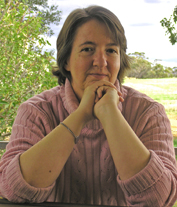
Let's all welcome back Australian fantasy author Katie Stewart. Previously I interviewed her about her debut novel, TREESPEAKER. Today she's here to tell us about one of her newer YA fantasy works, MARK OF THE DRAGON QUEEN.

-----

Kira has led a sheltered life, brought up by her widowed father, whom she adores. When he is arrested and imprisoned for a murder he allegedly committed 18 years before, she is devastated. So when she overhears an ex-student of her father's planning to visit the prison, Kira decides to go, too. However, the student - Arun - is not who she thinks he is, and she soon learns that her father has not always been the man of integrity she has known for fifteen years.

Caught in a rebellion against the Lord High Councillor who would return the country to Wizard Rule, Kira finds that there is one more lesson she has to learn - about herself. Success depends on her, but is she willing to make the sacrifice it will require? 


Something many readers seem to want to know is where an author got the idea for a particular story or novel. As a writer, I’ve learned that ideas can come from anywhere and everywhere - from major events to tiny things that might stay for years as a seed in the mind, until the right novel begs to be written. As Neil Gaiman puts it:

“You get ideas from daydreaming. You get ideas from being bored. You get ideas all the time. The only difference between writers and other people is we notice when we're doing it.”

In my "real" life – the one where I’m not pretending to be a writer – I work in the library of a small, private country school. It’s a great job, with a lovely crowd of people, and even if all my books were suddenly to become best sellers, I wouldn’t quit work entirely. In fact, my third book, MARK OF THE DRAGON QUEEN actually owes its existence, in part, to my job.

Two years ago, the school, along with the rest of the world, went through a financial crisis. Budgets were cut, including the one for the library. We had no money to buy books. No new books meant that there was little to do beyond the regular book changes with the children and shelving. So I found myself sitting for many hours, re-covering old books just for something to do. To ease the tedium, I listened to my iPod; more specifically, I listened to the musical, Les Miserables, which I’d just discovered and fallen in love with (I know, I’m a little slow on catching up with these things). As I listened to the story, I began to wonder what would happen if, instead of trying to escape from gaol for years, a man had to try to avoid going into gaol? What if he was given the chance to stay out of gaol, simply (or not so simply) by not doing what he had done wrong, ever again – with the punishment being death if he did? So, for example, what would happen if they’d killed with their right hand and were never allowed to use their right hand again? I mulled that over for a while and MARK OF THE DRAGON QUEEN, in which the protagonist’s father has managed not to use magic for eighteen years, was born.

Of course, the novel didn’t come together as a whole right there. It took a long time of what Ursula K Le Guin refers to as "composting" before the whole plot began to gel. Characters had to be found in the image library of my brain, a whole lot more what ifs had to be thought of and worked into a plot. It was like my first efforts at knitting as a child – it generally hung together, but was full of holes. In fact, I’d written quite a chunk of the first draft before I worked out exactly how the story would end. I’m definitely not a planner.

It seemed the more twists I put into the story, the harder I made it for myself. To start with, I had a main character who was very much concentrating on her father’s problems. That made it difficult to keep the perspective on target. Often I found myself slipping up, letting the father become the main focus and I had to rewrite whole sections. There was a prophecy which seemed to say one thing, but of course, there’s always a twist with a prophecy. That was tricky. Worse, it meant doing something horrible to one of my characters, a character I was very fond of, forcing me to write a scene that I hated myself for. I think it would have been easier to kill him off. On the other hand, his plight does give me a stepping stone into a sequel*.

To compost properly, you need the right tools. The ingredients have to be stirred and turned over. This was done with the help of members of my favourite critiquing site, Critique Circle . A hardy group of four to six other writers read my book, chapter by chapter, telling me what was good and what didn’t work. They encouraged me and chastised me for not writing quickly enough. Normally a writer wouldn’t have someone critique a first draft, but I tend to edit as I go, so what they read was reasonably edited, even if I wasn’t always entirely sure what I was doing! Then, when I’d completed the first draft, those same wonderful people read through the second draft. I don’t think I’ve ever been enthused about writing quite as much as I was with this book, and it took less than a year to get it completely written and edited. Actually getting it to the publishable stage took longer, because I’m not fond of the nitty gritty of e-publishing. I procrastinated wherever possible – designing the cover, working on the next book. However, I did get there in the end and MARK OF THE DRAGON QUEEN was published on New Year’s Day this year.

I never know what the theme of my book is going to be until it’s written. My books tend to be about relationships, and this one definitely is, with the main character’s love of her father being pivotal. It’s also about judging people on who they are now, rather than who they used to be, and about the opposition between love and power and how the two can’t exist together.

*I’ve had quite a few people asking me for a sequel to MARK OF THE DRAGON QUEEN and it will come – in time. I’m tentatively calling it ELLYETH'S HARP. At the moment, I’m working on the sequel to TREESPEAKER, which I hope to have out by mid-year. I’m also working on a children’s story which I originally wrote as a short story for my adopted son. It’s about a little Korean adoptee who finds an imugi – a Korean mythical serpent - which has come to Australia to discover the crystal that will allow it to become a dragon. That’s taking a bit of research, but I love research. It’s my favourite procrastinating tool.

-----

Thanks, Katie.

You can find more Katie at:

Saturday, December 17, 2011

A dream of a great tree: An interview with fantasy author Katie Stewart

Today I'm talking with fantasy author and artist Katie Stewart.

-----

1) Tell us about your book.

Treespeaker is a fantasy set in a forest in a Late Mesolithic-type society. It’s the story of a man who has long taken the idyllic nature of his life for granted, until he is forced to leave by a stranger from outside. Rejected by his own people, he sets out to find a way to save them from the slavery and death he knows the stranger will bring. In the process, he learns what he needs to know about himself for the new role he is to take on. That’s if he ever makes it home.

2) What inspired you to write this book?

A combination of things; firstly, I had a dream about a huge tree that provided sustenance for everyone who lived beneath it. It was a really strange but very vivid dream. Months later I found a picture of a tree in Ireland that was hundreds of years old and so like the tree in my dream that it was creepy to see it.

Secondly, I went through a patch in my life where I felt rejected by a group of people I’d always considered "my people". So, even though my main character is male, there’s a bit of me in him (though I didn’t set out to save anyone). The story is a long step away from my experience, but that’s where it started.

Thirdly, I came across a Scottish actor with a face that simply had to be written into a character. It took a while for the three things to stir together into a story idea, but when they did, the novel flowed easily.

3) Is there a main theme that defines your book?

When I first wrote my blurb, I said that it was a book about "balance, belief and belonging". The need for balance in everything comes out quite clearly. The people in the forest live in balance with the forest. The people outside the forest have lost that balance and are suffering the consequences. It comes across as an environmental theme, though I didn’t intend it that way. Stephen King would be proud of me! (He says a writer shouldn’t write to a theme but let it come out naturally.)

As for belief, I’m a firm believer in doing what you believe to be right, no matter what the rest of the world is saying. It’s often a hard road to follow. My character sets out in faith. It’s his belief in the ‘rightness’ of what he is doing that gives him the strength to go on.

Belonging is something that every human craves and when you lose it, it’s devastating. So the book explores that. In a way, the barrenness of the land outside the forest is a reflection of Jakan the Treespeaker’s state of mind when he is forced to leave. Life without the forest, without the ability to heal, is his worst nightmare.

4) The presence of some form of magic is a major portion, arguably, in what defines something as fantasy. Can you tell us a little about the magic system in your book?


The healing magic of the Treespeaker comes from Arrakesh, the spirit of the forest. A Treespeaker is able to hear the forest and use its energy to heal. He knows the forest’s will and can feel when something or someone is going against the flow of life in the forest. It’s gentle, subtle magic. No wham-bang spells or fireballs.

The antagonist, on the other hand, has magic defined by his own feelings. He can summon negative emotions into a ball of energy that will kill. He can control minds, both human and animal, to do his will simply by thinking it. So it’s magic from within, but because he chooses to use negative emotions, it eats away at him. This is something I explore more in the sequel that I’m writing at the moment.

5) Many current popular fantasy series are notable for their darkness, grittiness, and a tendency toward moral relativism. Some claim this is about imparting more "realism "to fantasy and arguably it's also just a strengthening of the Robert Howard-substrate of fantasy that was somewhat eclipsed by the success of Tolkien and Tolkien-inspired works that have dominated fantasy until relatively recently. Your book eschews gratuitious violence and sex. Was this in any part a reaction to the reign of grittiness in current fantasy?

My stories are very much a reflection of my own personality, I’m afraid! I’m a very quiet, introspective person and so my books tend to be the same. My personal heroes are people like Gandhi and Mandela, not those who charge into battle. I prefer characters who use their brains rather than muscle. At the same time, I try to keep the story twisting and turning enough to keep those pages flipping.

Sad to say, I’ve never read any Robert Howard. Conan’s muscles never attracted me. On the other hand I’ve never managed to read Lord of the Rings either, but that was Tolkien’s writing style, rather than his world –way too much description for me. I quite enjoyed the movies. Frodo is definitely the sort of hero I like. But then there are all those battles…not my scene.

I don’t know that I consciously reacted to the grittiness of other fantasy. I simply wrote the story that was in me. I like to read the sort of fantasy that I write.

6) Do you see your work fitting into any broad fantasy tradition similar to some of the ones I outlined above? Did you have any particular literary influences?


I think one of the problems I’m having is that my book doesn’t really fit into any particular fantasy tradition. I’ve had trouble trying to categorise it on Amazon and Smashwords because it doesn’t fit anything but "General Fantasy" which really doesn’t tell anyone anything. It’s what I think of as High Fantasy, in that I’ve created a completely new world, but that’s as close to categorising it as I can get.

I’m a great fan of Paolo Coelho, Ursula Le Guin and Juliet Marillier. They all write quite simply, but there’s a magic to their stories and their characterization is brilliant. I’d like to think something from their work has rubbed off on me, but I don’t know.

7) What was/were the book(s) that initially drew you into fantasy literature?

When I was a child, I read widely, but particularly liked historical fiction and the classics, which were, after all, historical in themselves. I read the Narnia Chronicles which I loved and had a particularly favourite book of English fairytales that I read and reread a hundred times. The artist in me loved to draw strange creatures and strange places that I’d seen in my dreams and in my imagination or read about in the fairytales.

When I was 19, someone lent me the Earthsea trilogy by Ursula Le Guin. I absolutely loved those books. I could see Le Guin’s world in my head and her characters were real, as if she’d sculpted the paper to form them and they walked right out of the book. I was smitten with fantasy and have been ever since. I know some consider her ‘old fashioned’ but as builder of completely new worlds, she’s second to none in my opinion.

I think though, that what really got my mind working towards maybe writing fantasy was an assignment I had to do at university. I’d started university expecting to do a degree in English, but one year of murdering beautiful books to get to "what the author really meant" was enough to put me off and I went into Anthropology and History instead. One of my Honours assignments was to "create a society" in detail, with all its social strata, economy, religion etc. I got an A+++ on that assignment, something I’d never managed before, simply because I enjoyed it so much. That godlike power of creating my own world was bliss! That’s what I really love about fantasy – being able to create something completely new and make it seem real. It satisfies the artist in me as well as the writer.

8) Can you tell us a little about your other works?

I have one other ebook out at the moment, a children’s fantasy called The Dragon Box. I wrote it for my son who was being bullied and it’s aimed mainly at boys, though I’ve had a few girls tell me they loved it, which is lovely.

I’m also working on getting another book out early in the new year. I’ve been calling it Young Adult, but like Treespeaker, I’m really not sure that it fits any particular category. The protagonist is a young girl, but it’s really a crossover novel. Anyone could read it and I hope they will. So I’m loath to lose it in the YA section where it might not compete well with zombies and sparkly vampires. Wherever it goes though, it is definitely fantasy and explores the opposition of power and love.

-----

Thanks, Katie.


If you'd like to see more from Katie, you can visit her at her website, http://www.katiewstewart.com/.

Treespeaker is available at Amazon, Smashwords, and Barnes and Noble.
The Dragon Box is available at Amazon.